viernes, 21 de septiembre de 2012

Cadáver exquisito

¡El viernes 14 de septiembre tuvo lugar el primer cadáver exquisito en el Continente! En el mismo participamos 10 autores: Lauta, Nico, Fede, Jony, Juli, Mechi, Ini, Migue, Afro, Baco.

Fundamento

Un cadáver exquisito es una composición colectiva - normalmente un texto o un dibujo - en la que cada autor no conoce más que las últimas palabras o líneas del autor anterior, y compone su parte a partir de las mismas. Al finalizar la composición, lo que se obtiene es una secuencia de fragmentos con un mínimo vínculo entre cada uno pero que, en términos generales, puede resultar en una coherencia sorprendente.
El objetivo principal, en nuestro caso, fue desarrollar las capacidades de escritura y de creatividad, con una actividad que a su vez fomente la interacción grupal. Justamente por esto, se decidió planificar la tarea de modo de poder escribir todos al mismo tiempo, y no secuencialmente.

Metodología utilizada

Puesta en común: tema y frases
Después de un muy entretenido debate, decidimos que el título del cadáver sería La primavera del cangrejo, y se trataría de un cuento de historias naturales (al estilo de Horacio Quiroga). Asimismo, elegimos frases que servirían de nexo entre cada uno de los textos, y sorteamos el orden de escritura. Ya con las frases y el título del cuento definidos, nos dedicamos a escribir nuestras partes, con la condición de mantenernos dentro de las 4 a 10 líneas cada uno. Finalmente juntamos las partes y, tras el almuerzo, leímos entre todos el resultado.
A continuación, ¡nuestro primer cadáver exquisito!

La primavera del cangrejo

La marea subió, y el atardecer de ese día soleado se esfumaba por el horizonte. Hortensia barrenó la última ola y decidió volver a la playa. Venía caminando por el fondo del mar, cuando dos peces de colores fluorescentes se le acercaron.
-Disculpa, me llamo Roberto – el más rojo le dijo – Con mi amigo estamos buscando la fiesta de las aletas coloradas, ¿sabés dónde es?
Hortensia no se ubicaba mucho por esos mares, pero decidió ayudarlos a llegar.
-Muchas gracias – le dijo el otro pez. Esa voz le resultaba familiar, era él, lo miró y le dijo a Nemo:
-¡Vos sos actor de Hollywood!
Nemo miró con cara de quien se sabe famoso, pero quiere mantener los pies sobre la tierra:
-Bueno, Hollywood… A veces voy a un evento o dos de esos, ¡pero me gusta pensarme más como un pez con suerte!
Hortensita lo miraba y sus ojos desorbitados no podían ocultar su fascinación por el personaje. A decir verdad, en la película estaba mucho más limpio y colorido, pero en vivo se notaban los detalles de las escamas brillantes y desprolijas, mucho más reales y atractivas para la joven cangrejita.
-¡Woooow, me encantó tu película! ¡Siempre sueño que me hago famosa actuando de princesa cangreja!
-Y sí… mucho sueñan eso, pero al final se da cuando menos lo buscás…
Nemo miró su reloj pulsera sumergible, y con cara de apurado dijo:
-¡Hora de mi entrenamiento diario!
Y sin despedirse, Nemo salió a entrenar sus aletas.
Hortensia no lo siguió y, solitaria, se sorprendió soñando lúcida; sucesivas imágenes de lo que le podría ocurrir a su compañero invadieron sus ojos. Como a la mayoría de los cangrejos, nunca le había gustado nadar, pero ante una aterrante visión de Nemo siendo masticado por veinte barracudas barrigudas, en un violento ataque vomitivo de impulsividad, decidió saltar del borde del arrecife y se lanzó hacia el abismo. Mientras caía lentamente ante la resistencia del agua pensaba:
-¿Qué estoy haciendo? ¡Yo jamás haría esto! ¿Está realmente pasando?
Hay un lugar donde no hay luz, donde no hay primavera, donde no hay sueños, donde la realidad y la ficción más fantasiosa se entremezclan como los tentáculos de dos pulpos en una pulseada. Donde no amanece: el fondo del mar.
Amanece en el barco, amanece en el mar.
Los primeros rayos de sol comienzan a escabullirse entre los párpados de Hortensia, obligándola a transitar el sendero que separa el sueño de la realidad. A medida que el mundo real gana terreno, un agudo dolor de cabeza la invade. Cubriendo sus ojos del sol con sus tenazas, se dijo a sí misma:
-Que resaca hermano, no puedo más.
Y luego, sin mirar a su compañero y con los ojos aún cerrados, le dijo:
-Che Nemo, pasame las aspirinas.
Pero Hortensia se enteró de que él se había ido.
Con él también se fueron los barcos, alejándose de la orilla en busca de pesca fresca de primavera. Hortensia se encontró sola y sin saber cómo protegerse en esta nueva temporada. Su sentido de la orientación todavía no estaba tan desarrollado y los procedimientos de los pescadores le eran desconocidos. La costa parecía ser un lugar seguro para esperar el anochecer. Tal vez ahí encontrara mas cangrejos a lo cuales podría unirse. Solo necesitaba entender hacia dónde debía caminar. Pero se encontraba en un lugar tan profundo que era imposible saber que dirección tomar. Le pareció ver haces de luz y se dirigió en ese sentido. Sin embargo cuando llegó al lugar comprendió que algo arriba suyo provocaba ese efecto. Un barco tal vez. Permaneció en el lugar y la luz se fue perdiendo de a poco hasta llegar a una negrura total.
-El fondo era más oscuro de lo esperado – piensa Hortensita.
-¿siempre será así? – dice para sus adentros mientras nada en la olla, grande y oscura.
Recuerda su niñez, sus paseos en la arena donde papá cangrejo le contó que en primavera los humanos reconectan con el nacer, con la vida, y no son tan propensos a matar para comer, prefieren una dieta verde, frutas y verduras que se entregan para alimentar. Sigue nadando, y recordando. Agua cada vez más caliente de por medio, se topa con un langostino que la mira afligido y suspira:
-¿Y la primavera? ¿No llegaba ahora? ¿Nos mintieron?
Una vieira lo abraza y casi para sus adentros suspira:
-Primavera, por favor, primavera.
Se sintió bien, no estaba sola. Al final, ella no era la única...todos esperaban la primavera.
Es que ya estaban cansados del frío del mar y la arena golpeando en sus cuerpos y rutinas. Hasta que al fin el invierno terminó, pudieron salir de sus cuevas, enfrentarse con el sol cálido y los turistas que llegaban a sus playas, pensaron que ahora sí iban a poder disfrutar. Y eso fue lo que pasó, se alegraron cada mañana al despertarse, Hortensita estaba feliz y pensaba que sus penas habían terminado. Pero luego de unos días algo falló, su destino se volvió a opacar… Como todos saben, la primavera termina.
Como todos saben, la primavera también comienza.
¡E incluso a veces es primavera, si tenemos suerte!
Y nuestra historia transcurre justamente en primavera, lo cual es poco común. Esto no debe sorprenderlo, querido lector, ya que también Hortensia era una cangreja poco común.
Se había percatado ella solita de su naturaleza especial. No por nada debía asistir a colegios especiales, aceptar amigos especiales, y hasta comer algas para nada ricas, pero especiales al fin. Al mismo tiempo, sus padres, biólogos genéticos de renombre en aquella región marítima, le recordaban con constancia e intensidad que ella había nacido para “ser especial”, y que las restricciones que le imponían eran sólo por su propio bien.
Hortensia existía dentro de una burbuja de confusión y aceptación.
-¿Por qué no puedo disfrutar como los demás cangrejos, las bondades del mar?
-¿Por qué debo comer solo alimentos preparados para mi?
-¿Por qué estoy confinada a las paredes del laboratorio de experimentos de mis padres?
-¿Y por qué, cada vez que me enfurezco, mis tenazas exponen un brillo incandescente verde fluo, al mismo tiempo que comienzan a agrandarse desmesuradamente?
Estaba confundida, decidida a cambiar.
De a poquito, fue rebelándosele a los hábitos impuestos. Empezó por demandar comer algo que realmente le gustara, con la esperanza de que este primer paso fuera fácil.
A caparazón firme, se acercó al sector de Nutrición del laboratorio, se plantó delante de Gutiérrez, el encargado, y le dijo:
-Quiero una crema helada de fitoPlankton.
Gutiérrez se congeló. Entendió la situación, pero decidió desligarse y llamar a Galíndez, el chef de turno. Galíndez se acercó, después de escuchar la historia, y frunció el entrecejo:
-Hortensia, ¿Estás segura de lo que haces? – le preguntó mientras se rascaba sus avejentadas branquias.
-Si – su voz, firme como la nariz de un tiburón martillo.
El chef miró a Hortensia a los ojos. Sabía de su deseo de vivir, y deseaba no ser el encargado de poner fin a semejante aventura. Pero el deber obliga, y tenía la orden de hacer ese plato específico de cena. Aun así, y en un aire de valentía, liberó a la pobre cangreja, soltándola a su suerte en el mar, e improvisó un intento de cangrejo con otros ingredientes del lugar.
Llegó el momento de presentarle el plato a tan famoso comensal, y con manos temblorosas fue él mismo el encargado de entregar la presa. Sin embargo, no contaba con la respuesta del personaje, respuesta que cambiaría su humor y le devolvería el aire al cuerpo:
-No gracias, soy alérgica a los crustáceos

viernes, 14 de septiembre de 2012

Renewable Energy: New world, new challenges


The development of new technologies for storing renewable energy seems to be a key aspect for the energetic "turnaround". With this post we want to illustrate this point, and motivate you to keep reading and learning about what is going on in the fascinating world of clean energies.

This article shows some results and challenges of using lithium ion batteries connected to the energy generators: "the fluctuating supply of electricity based on photovoltaics and wind power can be stored until the time of peak consumption".


http://www.energyharvestingjournal.com/articles/storage-systems-for-renewable-energy-00004648.asp?sessionid=1

A fundamental requirement of energy supply, comes from strong fluctuation in energy consumption. With appropriate storage and fast discharge, energy requirements during peaks in energy consumption can be supplied with minimum "effort". This means being able to "fluctuate" in supply, minimizing the cost of generation overall. The following article discusses the impact development of new technology could have. "When storage becomes cheap and massive, the impact will be huge.”


http://www.bloomberg.com/news/2012-08-27/ski-lifts-help-open-25-billion-market-for-storing-power-energy.html?cmpid=yhoo

Another important reason for needing optimal storing energy comes from the fluctuation of output of the renewable sources. For example, for a 4KW photovoltaic generator, "cloud cover can cause generation to drop by 80% in just a few seconds" according to SaftBatteries.

Apart from minute-to-minute variations, we also have daily variations in the generation of both wind an solar energies, due to the obvious dependency of climatic variables. As an example, the following graph shows energy output for wind generation in Ireland for different days:

So, not only is storage important for "demand-buffering" but also for "supply-buffering". Apparently, it is the current bottleneck for a potential massive conversion to clean energies. It is not an easy challenge, but the first step of recognizing the problem has been made.

The following links show different experiments using super-capacitors with pen ink and iron-air batteries as alternatives:


Are any of them definite solutions? Apparently not yet, but the wind seems to be blowing on our backs, pushing us forward to a new world...

viernes, 7 de septiembre de 2012

Seeking true Matrix

Once upon a time... Matricks!
Morpheus: This is your last chance. After this, there is no turning back. You take the blue pill - the story ends, you wake up in your bed and believe whatever you want to believe. You take the red pill - you stay in Wonderland and I show you how deep the rabbit-hole goes. Remember... all I'm offering is the truth. Nothing more.
What about the red pill? Are we sure we want to know anything about the rabbit-hole? We are usually working on models, making our own representations of reality. It is part of our job, to make our own matrix, in order to interact with it, looking for the truth, either the truth in the past or the expected one in the future. Bottom line, we´re in charge of making things work, first in fiction and then in reality.
Morpheus: What is the Matrix? Control. The Matrix is a computer-generated dream world built to keep us under control in order to change a human being into this [holds up a Duracell battery].
Neo: No, I don't believe it. It's not possible.
Morpheus: I didn't say it would be easy, Neo. I just said it would be the truth.

But, how can we do to make those things work? Mainly, we need a good vision of reality, given by people who interact in that reality. Once we know what has to be represented, the first step is already being taken.
Morpheus: I'm trying to free your mind, Neo. But I can only show you the door. You're the one that has to walk through it.
As a comparison between what we do and the concept behind the film (and because we are big fans of it), we decided to make a simple model that represents the way we act, just for doing it. This is how Matricks was born, with basic controls and a hidden truth behind the numbers, that we hope you enjoy discovering!
Morpheus: Unfortunately, no one can be told what the Matrix is. You have to see it for yourself.
Press on the red pill to run the model
Note: the name "matricks" arises from the conjunction of "Matrix" and "tricks", due to the trick hidden in the model

lunes, 27 de agosto de 2012

Programa Comunicación Digital


Redes Sociales y la empresa

Las Redes Sociales de Internet (Facebook, Twitter, Google+, etc.) vienen cobrando cada vez más protagonismo. Hasta en el mundo de los negocios, hoy forman parte de la Comunicación Digital de cualquier empresa. En Continente Siete vemos el valor de estos canales, y hemos estado tratando de apalancarlos desde un principio.

Mantener la disciplina

Los Canales Digitales admiten altos niveles de información. Es por eso que muchas empresas optaron por crear equipos dedicados para la creación de contenido y la comunicación en los mismos. En Continente Siete buscamos la participación de todo C7er (y el tamaño de la empresa no justifica tener a una persona dedicada únicamente a estos canales) por eso intentamos un enfoque diferente.

Hace aproximadamente un año, un equipo de 3 personas dedicó sus días D (día dedicado al desarrollo de proyectos de interés personal) en entender y establecer los usos correctos de cada canal. El output de este proyecto fue el armado de una política de comunicación descentralizada, con pautas y guías para un efectivo uso, en donde cada C7er puede efectuar una comunicación oficial de Continente Siete por estas vías.

Resultados: el nivel de comunicación aumentó significativamente. Sin embargo, el costo de generación de contenido era alto y el incentivo bajo, llevando a un flujo esporádico de información que subutilizaba los canales.

Apalancando en múltiples puntos

Hace unos meses el problema recobró importancia, y un equipo de Continente Siete decidió montarse sobre la solución anterior. Esta vez, no solamente se trabajaría en la política, sino también en la organización y el incentivo.

Organización

Se usó el Trello (www.trello.com es una aplicación web que sirve como herramienta para la gestión de proyectos AGILE) y se creó un tablero para organizar el flujo de comunicación digital. En el tablero hay 3 listas: Repositorio, Programados y Posteados Recientemente. 


En el Repositorio cada C7er puede crear una tarjeta con un link a un artículo interesante, o agregar contenido propio. En esta misma tarjeta la persona se auto-asigna y sugiere a través de un código de colores los canales en los cuales cree que vale la pena comunicar.

Un encargado luego pasa estas tarjetas a Programados, en donde se le agrega una fecha de “posteo” que la persona asignada deberá respetar.

El encargado es un C7er diferente cada mes, y un Google Spreadhseet se encarga de comunicar a quién le corresponde el cargo.

Incentivo

“Gamification is the use of game design techniques, game thinking and game mechanics to enhance non-game contexts” – Wikipedia

A través de este concepto de Gamification es que se intentó agregarle incentivo al sistema. Se creó un monitor en el cual el C7er que ejecuta la comunicación debe registrar sus “posteos”. El mismo monitor muestra las últimas tendencias de los “posts” en Continente Siete, y, para cada persona, le asigna un nivel por cada canal de comunicación (por ejemplo, un C7er puede ser Level 1 Facebook, y al mismo tiempo Level 4 Blog C7). También cada C7er tiene un Puntaje y Nivel total de acuerdo a qué tanto avance tenga en los diferentes canales.


De esta manera se generan Rankings que permiten a los C7ers entrar en una sana competencia para ser el mejor comunicador.

En un futuro cercano también se agregarán Awards y premios reales para continuar en la curva ascendente de Incentivos.

Resultados y últimas palabras

Desde su implementación hemos tenido un flujo constante de comunicación a través de los diferentes canales, sin perder la calidad de la misma. La exposición ha aumentado significativamente. Si bien se agrega un costo extra que es el de registrar el “posteo”, el beneficio por facilitar la creación de contenido y por el incentivo, parece ser mayor.

Queda por re-analizar los parámetros de uso correctos de cada canal, ya que no queremos saturarlos y perder audiencia por esto.

Gracias Jose, Mechi, Migue y Juancho por ayudar a armar este programa!

Ahora, aprovecho y me sumo un puntito en el Blog C7.

viernes, 17 de agosto de 2012

Optimizing Milk Runs with WSA

Imagine your job is to schedule the pick-up and delivery of certain goods. Everyday, you will receive orders that vary in many ways: there are many suppliers from which to pick-up; different order sizes; different lead times; different delivery dates and time windows! With this information, you must decide how to satisfy the demand, using your limited resources….

It’s not a simple job! Unless you have an unlimited fleet of trucks that don’t use fuel, and a group of drivers willing to make ridiculous trips at no cost, you will be motivated to design optimal routes. Added to these obvious economic reasons, you should also be considering pollution and traffic congestion!!

OK, don’t panic... There are several ways of tackling this problem, and one of them is the Wright’s Saving Algorithm, a deterministic method that groups clients in order to reduce the total distance travelled by trucks.

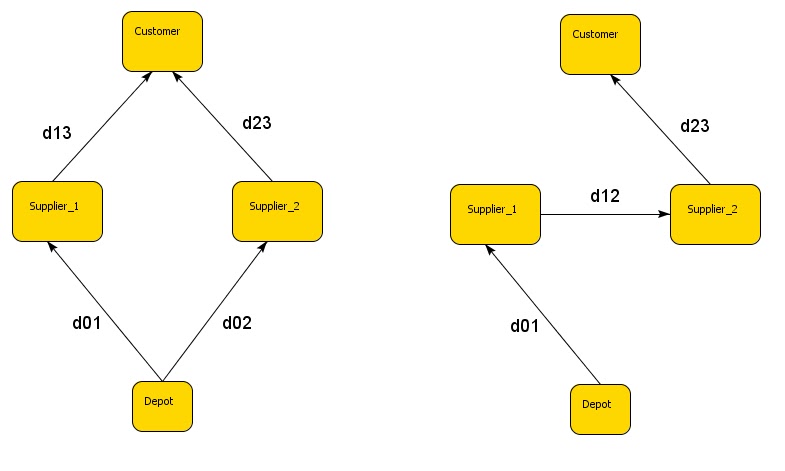
The procedure is very simple, and results are suprising! It consists of pairing all orders, and calculating the kms saved by grouping these two suppliers. This image shows how in this case, grouping suppliers 1 and 2 would generate a saving: S=d13+d02-d12. 
The negative term in the saving comes because pairing suppliers adds a new route: the one connecting both suppliers. If this distance is greater than the positive terms, then pairing these suppliers will have a "negative saving", indicating that its best to visit both separately (if we consider distance as the only cost indicator).

The algorithm then analyzes all combinations, ordered by greater saving, and assigns orders to the available trucks, considering capacity and fuel restrictions.

You can try the model we developed here: http://www.runthemodel.com/models/825/

In the example, you have to locate the suppliers in the green area (by clicking and dragging) and click the START button. You will see how new orders that arrive each day are assigned to the different trucks. Try pausing the model when orders arrive and thinking how you would assign the demand to the available trucks. Then compare your ideas with the algorithm! With few suppliers you will probably be able to match the results (or even beat the algorithm!), but try adding suppliers, and the problem will become exponentially more complex!!

Milk Runs tour re-make

Simulation model Milk Runs tour re-make created with AnyLogic - simulation software / Transportation & Logistics
Run the modelDeveloped with
simulation software AnyLogic

jueves, 9 de agosto de 2012

OF VEGETABLES AND POLISH TRIANGLES

     What do a fern and a snowflake have in common? If I were to tell you that they relate in the same way as DNA relates to Romanesco broccoli, would it strike you as odd? They are all cases of natural-given self-similarity. In mathematics, a self-similar object is exactly or approximately similar to a part of itself (this contradicts the popular saying: beautiful from afar, but far from beautiful).

     A couple of weeks ago I came across a creation of the Polish mathematician Warclaw Sierpinski and was amazed by its simplicity and beauty. The Sierpinski Triangle is a self-similar fractal figure created by following a very simple algorithm. In fact, the algorithm is so simple that you can draw it on a sheet of paper while reading this post:
  1. First draw an equilateral triangle the size of the palm of your hand
  2. Choose a random point inside the triangle and mark that point with a pen or pencil.
  3. Randomly choose a corner of the triangle.
  4. Mark a new point halfway from the last point you drew and the previously chosen corner.
  5. Randomly choose a new corner (it may be the same one you chose before).
  6. Repeat steps 4 and 5 indefinitely (do this a couple of times).

Note: You probably won´t notice anything extraordinary by doing 10 or even 50 iterations.

     I would recommend you draw a couple of points in order to understand the algorithm but leave the ‘indefinitely’ part to a machine. At Continente Siete we modelled this simple algorithm and will leave it for you to discover what emerges from the seemingly trivial steps you have followed.

     You can run the model by following these three steps:
  • After starting the model, click inside the displayed triangle to select an initial point
  • Repeatedly click on the ‘Add point(s)’ button located on the upper right of the window (select the ‘Auto Add Point(s)’ checkbox to do this automatically).
  • Observe the emerging pattern (note: speed up the process by adding several points  at a time with the ‘Add points’ slider located on the upper right of the window).


     We welcome you to discover and experiment with the other features included in the model.

     Maybe the next time you eat broccoli you´ll take a closer look and appreciate the mathematics behind nature.


viernes, 3 de agosto de 2012

Winter 2012: Slalom!

Temperature gets colder, people start using (once again) their heavy clothes, sky turns grey, raindrops start falling... Winter is here! And together with it, mountains get white, and ski resorts start working, preparing the slopes for future competitions.
Our offices are located far away from those mountains, but that did not stop us from creating our own Slalom model!


In this new game, you have several skiers who compete in a first race, with three principal charasteristics:
     - velocity: it determines the velocity that each skier has to descend the slope.
     - reaction: it represents the ability to change the direction.
     - precision: a better precision gives the skier a better accuracy on aiming the following chek point.

After that first race, the best skiers remain and compete in the next stage, and new skiers are introduced, with their parameters defined as a combination of the previous winners. This way, you get an 'evolution' in the parameters, and after several stages you get a good combination of parameters, possibly a local optimum given the initial combination (of the first skiers).
In fact, if you keep running the model, you'll find that the best combination isn´t a trivial one, but instead it depends on how the circuit is made, and how the skier responds to it.

One of the most attractive features of the model is the visualization of the skiers. The default visualization is from above, but pressing the green button you can see how the skis turn on each curve and, pressing the next green button, you might even see the skier from the front.

the link to run the model is the following one:

We hope you enjoy it!